
AI Greenhouse Control
Verdify is a public case study in AI-assisted greenhouse control. The useful claim is narrow: the AI planning agent can read greenhouse context, write bounded tactical intent, and be judged later against measured climate, plant-stress, resource-use, and plan-quality evidence.
That is different from saying the AI directly runs the greenhouse. It does not. Verdify keeps the slow reasoning loop and the physical relay loop separate, then publishes enough of both for a reader to check the claim.
What The AI Planning Agent Adds
The AI planning agent is valuable when the decision is slower than a relay tick and depends on context: today’s forecast, crop targets, previous outcomes, equipment health, cost, water, physical constraints, and current alerts. It writes a physical hypothesis: what posture should the greenhouse take, what tradeoff is being made, and what result should be visible later.
The implementation details have their own homes:
How context becomes MCP writes, dispatcher delivery, scorecards, and lessons.
Exact triggers, payload shape, required outputs, accepted tunable writes, midnight review, and automatic site publishing.
The exact parameters, bounds, ownership, defaults, and readback status.
The generated packet, event prompts, audit headers, and trim policy the planner receives before planning.
Why the ESP32 owns physical state and how dispatcher validation sits between the planner and firmware.
Why This Is A Useful Testbed
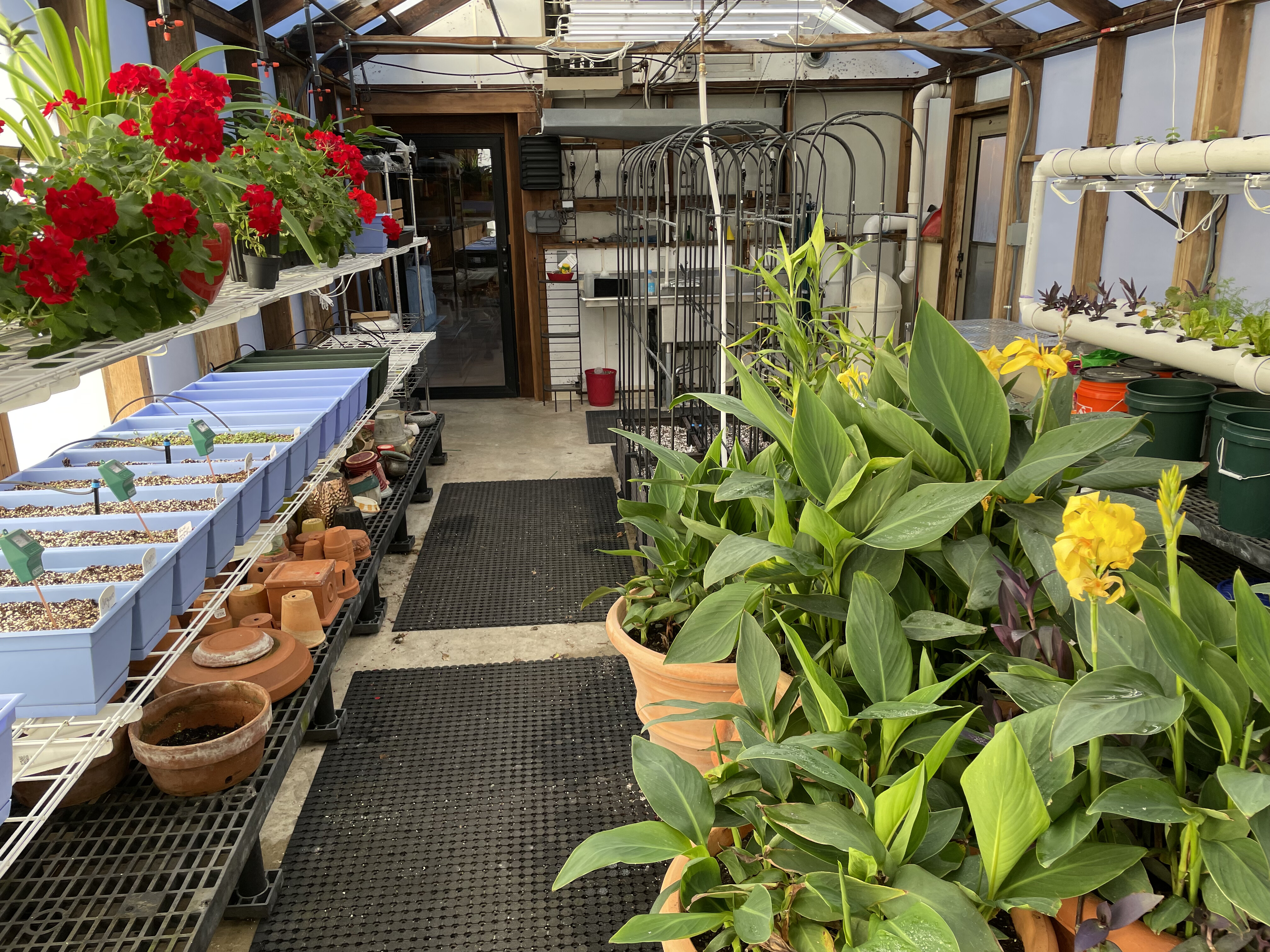
Most greenhouse automation demos get to choose friendly conditions. Verdify does not. The Longmont greenhouse sees cold nights, dry Front Range afternoons, strong high-altitude sun, spring shoulder-season swings, tree shade, mixed crops, and a small envelope where one air decision affects every zone.
Those conditions make vague AI claims less useful. The interesting question is not whether a model can sound confident about greenhouse control. The question is whether its bounded plans reduce stress or expose a better next experiment when physics wins.
Where The Proof Lives
This page is the doorway, not the evidence warehouse. The proof pages below own the measurements.
Physical climate pressure, safe bands, and zone behavior.
Planner score, compliance, stress hours, forecast error, journal rows, and lessons.
Utility timing, cost proof, public rate assumptions, and solar-alignment evidence.
System health, current controller state, alerts, equipment, and diagnostics.
Generated daily plan records plus the planner-offline comparison window.
What Verdify Is Not Claiming
Verdify is not claiming full autonomy, closed-loop yield optimization, or profit superiority. Those would require more harvest records, crop-stage normalization, comparable baselines, and a longer operating history.
The claim today is more modest and easier to audit: a real greenhouse can expose AI planning decisions, physical telemetry, failures, costs, and lessons in public, while keeping deterministic control at the edge.
Technical FAQ
The AI planning agent writes planned tunables, validated tooling delivers them, and firmware controls hardware. The relay-boundary argument lives in Safety Architecture, and the exact tactical parameters live in AI Tunables Traceability.
The planner reads greenhouse context, forecast, prior outcomes, and lessons, then writes a plan that can be measured later. Planning Loop owns the step-by-step version.
Missed plans are visible in the planning archive, and Safety Architecture owns the failure behavior.
The planner gets live greenhouse state, forecast pressure, active plan context, scorecards, validated lessons, alerts, and curated site context. It does not rely on open-ended chat memory.
Temperature and VPD can fight each other. Ventilation can cool the greenhouse while importing dry air. Misting can lower VPD while trapping heat if the room stays sealed too long. Gas heat, electric heat, fog, fans, vents, misters, grow lights, water budget, forecast error, and crop bands all interact.
Simulator-trained policies may become useful later. Verdify has one physical greenhouse, so exploration mistakes have plant and hardware consequences. The next credible step is counterfactual replay against recent telemetry.
Every plan is a hypothesis, the next cycle measures the outcome, and durable findings become lessons that future plans read. The lesson lifecycle lives on Planning Loop and Lessons.
VPD combines temperature and moisture into a better plant-stress signal than relative humidity alone. Climate Control owns the live temperature/VPD evidence, and the Scorecard owns planner outcome proof.
The greenhouse has finite cooling capacity, dry outdoor air, solar gain through polycarbonate, and mixed crop targets. Good planning means reducing avoidable stress and logging the physical limit when the greenhouse cannot hold band.
The public proof layer is focused on system automation: climate tactics, relay-boundary enforcement, telemetry, costs, failures, and lessons. Yield and profit claims need more harvest records, crop-stage normalization, and comparable baselines.
The archive shows the missing plan. The scorecard shows the plant-stress consequence. The controller behavior is covered on Safety Architecture.
The home has rooftop solar and batteries, so the greenhouse can operate through some electrical constraints and align flexible loads with production. It still uses grid electricity and still needs gas heat during very cold conditions. Resource Use owns utility consumption, solar timing, public rate assumptions, and cost accounting.
Architecture owns what can be inspected or reused, and what stays out of the public surface because the live system controls real equipment.
Next
- The Planning Loop for implementation sequence.
- Safety Architecture for the relay boundary.
- Evidence Map for all live proof routes.
- Climate Control for physical constraints and Lessons for validated operational findings.
- Related Work for peer comparisons.