

High-Altitude Greenhouse Climate Control
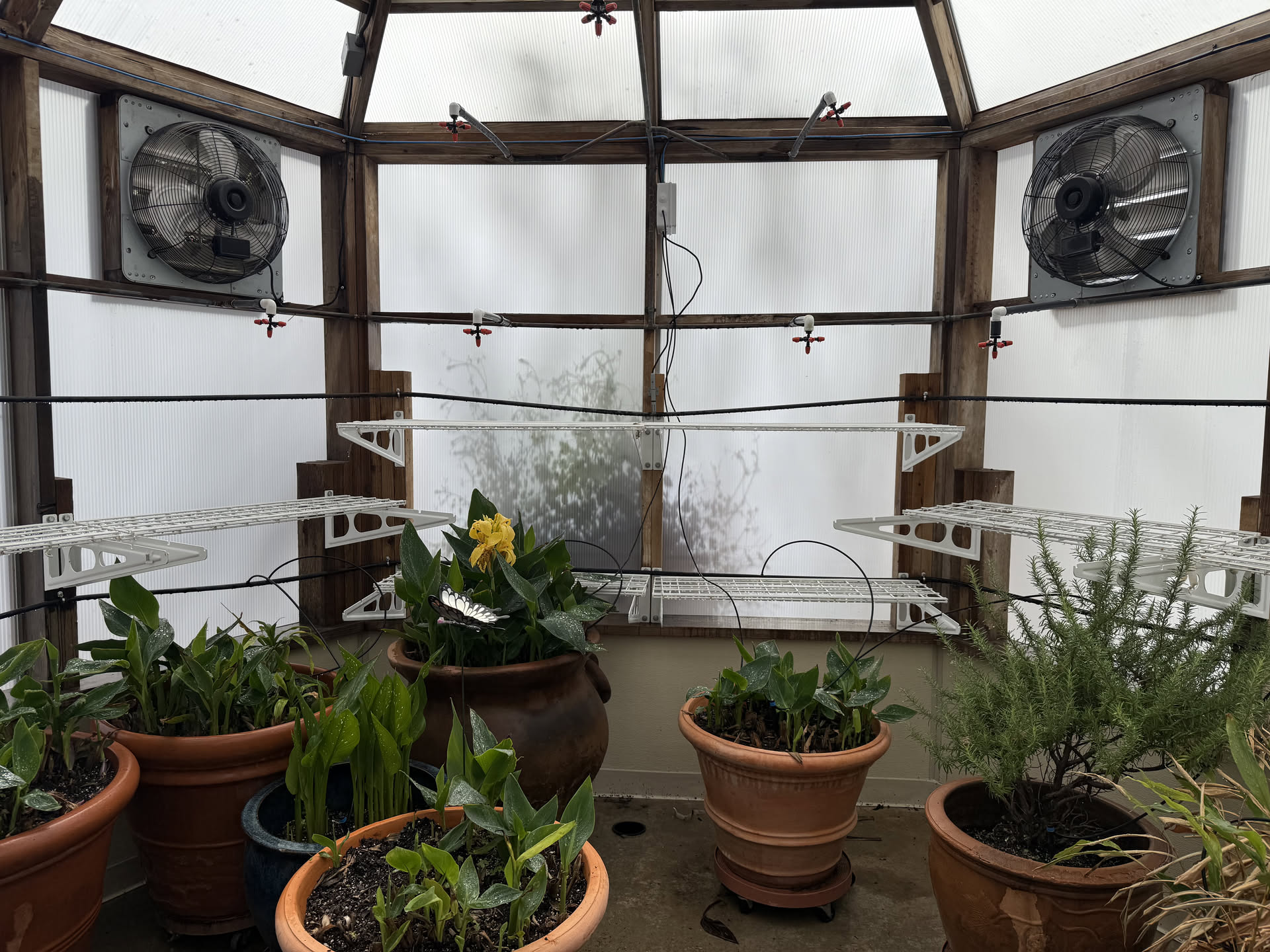
Verdify is managing a hard physical climate problem, not a thermostat demo. The Longmont greenhouse gets strong high-altitude sun, dry afternoon air, cold nights, and fast daily swings. The ESP32 controller influences that climate with heaters, exhaust fans, a motorized vent, fog, mist zones, grow lights, and water systems; the AI planner can only adjust bounded tactics documented in AI Tunables Traceability.
The recurring tradeoff is simple: cooling wants outside air, while VPD control often wants the greenhouse sealed and humid. Forecasts shape that posture, but they are imperfect; see the forecast page for current risk windows and recent forecast misses. Durable operating findings live in Lessons.
What The Equipment Can Change
Protects minimum air temperature and overnight crop safety, bounded by glazing losses and outdoor lows.
Rejects heat and exchanges air, bounded by outdoor temperature, solar load, and airflow geometry.
Buys humidity retention and some evaporative support, bounded by Longmont dry air and available water contact time.
Moves the next correction toward the zone that needs it, bounded by fixed structure, tree shade, and plant density.
Supplements light for hydro/shelf crops, bounded by solar angle, fixture placement, and electricity cost.
Live Climate Pressure
These public panels keep the climate page focused on the variables plants actually experience: air temperature, VPD, and incoming solar pressure. Runtime, relay state, cycles, and device-level diagnostics live on Operations.
Solar irradiance is a trend, not a current-value proof card. At night it should read near zero; what matters for control is the last day and next two days of solar heat load.
Control Paths
Temperature and VPD are coupled, so the controller does not have a single “make it better” lever. Heat protects cold nights. Fans and venting reject solar heat but can import dry air. Fog and misters recover humidity and sometimes add evaporative cooling, but they also consume water and can fight ventilation. The AI planner writes bounded targets and tactics; the controller decides which equipment state is safe.
For runtime, cycles, equipment-now, and device-level diagnostics, use Operations. For cost and circuit-level usage, use Resource Use.
Dispatcher Target Tracking
The dispatcher owns the low, target, and high bands for temperature and VPD. The signed deltas below show actual climate against that dispatcher-owned target. Positive temperature delta means the house is hotter than target; positive VPD delta means the house is drier than target. Band error clips to zero while the house remains inside the acceptable low/high band.
Electric heat handles mild protection and gas heat carries larger cold loads. Heating choices are visible in controller state, equipment runtime, and Resource Use.
Fans and venting can lower temperature quickly, but outdoor air often raises VPD. The planner can bias thresholds; firmware still enforces the state machine.
Moisture tools target VPD pressure and wettable zones. They are bounded by dew-point risk, direct-wet windows, water budget, and temperature safety.
Grow lights fill useful-light gaps, but they also add electrical load and heat. Lighting details live on Greenhouse Lighting.
External Pressure And Forecast Misses
The controller is reacting to outside conditions, not just internal sensors. Forecast misses matter when expected sun, cloud cover, cold, or humidity does not arrive on schedule; a good plan should update the posture without pretending the earlier forecast was true.
Sun can turn a cool day into a ventilation problem. The solar trend above shows why the same setpoint can be easy in the morning and hard at noon.
Outdoor VPD can make ventilation solve heat while worsening plant drying pressure. Moisture tactics need to track the actual outside air.
When outdoor lows fall hard, greenhouse safety depends on heat capacity, not AI autonomy. Resource Use owns the gas/electric cost evidence.
Observed-vs-forecast misses can trigger a bounded replan or acknowledgement; the Scorecard owns planner outcome and forecast-accountability panels.
Zone Behavior
The greenhouse is not one climate. South is the hardest hot-zone problem. East stays cooler because of tree shade and patio-door ventilation. West is flexible but swings harder in late afternoon. The heat spot rotates through the day, which means averages hide the real plant experience.
Where To Go Next
The physical shell and altitude assumptions are documented in Physical Structure. The controller boundary is documented in Safety Architecture. The exact planner-controlled climate knobs are listed in AI Tunables Traceability, the current weather input is on Forecast, durable findings are on Lessons, and the resource-use story lives in Resource Use.